{"_id":"@1-/vernext","_rev":"2-56380ff5a66729839b4d4998f021b435","name":"@1-/vernext","dist-tags":{"latest":"0.1.1"},"versions":{"0.1.0":{"name":"@1-/vernext","version":"0.1.0","keywords":[],"author":{"name":"x-at-01@googlegroups.com"},"license":"MulanPSL-2.0","_id":"@1-/vernext@0.1.0","maintainers":[{"name":"i18n-now","email":"i18n.site@gmail.com"}],"homepage":"https://github.com/webc-site/npm/tree/main/vernext","bugs":{"url":"https://github.com/webc-site/npm/issues"},"dist":{"shasum":"7edba586c5e2837f75462795f13ccbfbbc64a43e","tarball":"https://registry.npmjs.org/@1-/vernext/-/vernext-0.1.0.tgz","fileCount":3,"integrity":"sha512-HbihbBimYwXVmUpcUh0JCNorngUuQC4Yd06PMP8SjFqR4naXABgHmEnGc2zRS9CaR+YOCqMrJe279NntYLS8uw==","signatures":[{"sig":"MEUCIQC2hMUPwEzYV/OFL4fLtMp7S3OZ1cLTcsyu7Qem8ZfNlAIgS9lTnUoo7S4iG+gdCp4eUSwBaC+AGWC0CUWylKfodO0=","keyid":"SHA256:DhQ8wR5APBvFHLF/+Tc+AYvPOdTpcIDqOhxsBHRwC7U"}],"unpackedSize":4958},"type":"module","exports":{".":"./_.js","./*":"./*"},"_npmUser":{"name":"i18n-now","email":"i18n.site@gmail.com"},"repository":{"url":"git+https://github.com/webc-site/npm.git","type":"git"},"_npmVersion":"11.16.0","description":"[English](#en) | [中文](#zh)","directories":{},"_nodeVersion":"26.2.0","_hasShrinkwrap":false,"_npmOperationalInternal":{"tmp":"tmp/vernext_0.1.0_1783328080716_0.9653480847512212","host":"s3://npm-registry-packages-npm-production"}},"0.1.1":{"name":"@1-/vernext","version":"0.1.1","description":"Increment the last numeric segment of a semantic version string.","description_zh":"递增语义化版本号字符串的末位数字段。","keywords":["semver","version","increment","patch","utility"],"homepage":"https://github.com/webc-site/npm/tree/main/vernext","license":"MulanPSL-2.0","author":{"name":"x-at-01@googlegroups.com"},"repository":{"type":"git","url":"git+https://github.com/webc-site/npm.git"},"type":"module","exports":{".":"./_.js","./*":"./*"},"_id":"@1-/vernext@0.1.1","bugs":{"url":"https://github.com/webc-site/npm/issues"},"_nodeVersion":"26.2.0","_npmVersion":"11.16.0","dist":{"integrity":"sha512-JKE1T3xsFoHAdJscMIj00w/gdrzVn85KXFcEWxm8aAZ92aLMtbysjVMwIo/ajmq5thkHTHvzXd7vYkwZyGUodg==","shasum":"66fda1906cd4eecf93717f9c459f90db5d0b210e","tarball":"https://registry.npmjs.org/@1-/vernext/-/vernext-0.1.1.tgz","fileCount":3,"unpackedSize":5158,"signatures":[{"keyid":"SHA256:DhQ8wR5APBvFHLF/+Tc+AYvPOdTpcIDqOhxsBHRwC7U","sig":"MEUCIBd5YUkWUomgWfK94fGyiaMheRgA7sNWEOiWlItdipRwAiEAuulwvtCh0Zgl3LVnunoE16XNY+GqOFKKdE7BhqNvjaI="}]},"_npmUser":{"name":"i18n-now","email":"i18n.site@gmail.com"},"directories":{},"maintainers":[{"name":"i18n-now","email":"i18n.site@gmail.com"}],"_npmOperationalInternal":{"host":"s3://npm-registry-packages-npm-production","tmp":"tmp/vernext_0.1.1_1783328263398_0.6842651994047746"},"_hasShrinkwrap":false}},"time":{"created":"2026-07-06T08:54:40.588Z","modified":"2026-07-06T08:57:43.640Z","0.1.0":"2026-07-06T08:54:40.836Z","0.1.1":"2026-07-06T08:57:43.518Z"},"bugs":{"url":"https://github.com/webc-site/npm/issues"},"author":{"name":"x-at-01@googlegroups.com"},"license":"MulanPSL-2.0","homepage":"https://github.com/webc-site/npm/tree/main/vernext","keywords":["semver","version","increment","patch","utility"],"repository":{"type":"git","url":"git+https://github.com/webc-site/npm.git"},"description":"Increment the last numeric segment of a semantic version string.","maintainers":[{"name":"i18n-now","email":"i18n.site@gmail.com"}],"readme":"[English](#en) | [中文](#zh)\n\n---\n\n\n# @1-/vernext : Increment semantic version number last segment\n\n- [@1-/vernext : Increment semantic version number last segment](#1-vernext-increment-semantic-version-number-last-segment)\n - [Functionality](#functionality)\n - [Usage demonstration](#usage-demonstration)\n - [Design rationale](#design-rationale)\n - [Technology stack](#technology-stack)\n - [Code structure](#code-structure)\n - [Historical context](#historical-context)\n - [About](#about)\n\n## Functionality\n\nThis library solves the problem of programmatically incrementing the last numeric segment of a semantic version string. Given a version string (e.g., \"1.2.3\", \"2.0\", or \"5\"), it increments the final digit field by 1 and returns the updated version string.\n\n## Usage demonstration\n\nInstall the package:\n\n```bash\nnpm install @1-/vernext\n```\n\nUse in your JavaScript code:\n\n```javascript\nimport vernext from \"@1-/vernext\";\n\nconsole.log(vernext(\"1.2.3\")); // '1.2.4'\nconsole.log(vernext(\"2.0\")); // '2.1'\nconsole.log(vernext(\"5\")); // '6'\n```\n\n## Design rationale\n\nThe implementation uses a simple string-based approach to locate and increment the last segment of the version number. This avoids dependency on complex version parsing libraries while maintaining reliability for standard semantic versioning patterns.\n\n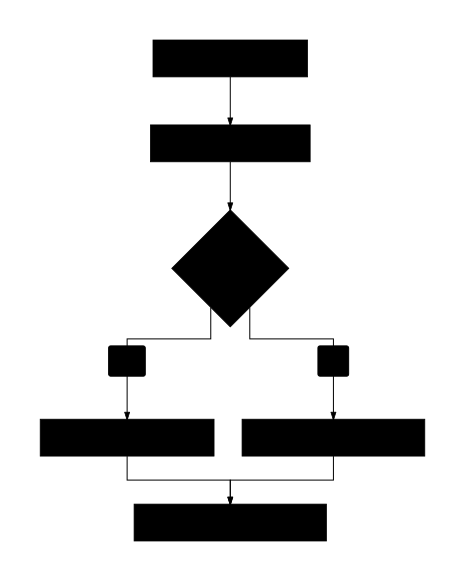\n\n## Technology stack\n\n- JavaScript (ES modules)\n- No external dependencies\n- Compatible with Node.js and modern browsers\n\n## Code structure\n\n```\nsrc/\n└── _.js # Main module exporting the version increment function\n```\n\nThe core functionality is implemented in a single, concise file that exports a default function.\n\n## Historical context\n\nSemantic versioning was introduced in 2012 by Tom Preston-Werner, creator of GitHub, to provide a clear and consistent way to communicate the nature of changes between software versions. The concept of version numbers dates back to the early days of computing, with IBM's OS/360 in 1964 using version numbers to track software releases. This library implements a fundamental operation in the semantic versioning workflow — incrementing the patch version for bug fixes.\n\n## About\n\nThis library is developed by [WebC.site](https://webc.site).\n\n[WebC.site](https://webc.site): A new paradigm of web development for AI\n\n\n---\n\n\n# @1-/vernext : 递增语义化版本号末位段\n\n- [@1-/vernext : 递增语义化版本号末位段](#1-vernext-递增语义化版本号末位段)\n - [功能介绍](#功能介绍)\n - [使用演示](#使用演示)\n - [设计思路](#设计思路)\n - [技术栈](#技术栈)\n - [代码结构](#代码结构)\n - [历史故事](#历史故事)\n - [关于](#关于)\n\n## 功能介绍\n\n该库解决程序化递增语义化版本号末位数字的问题。给定版本字符串(例如 \"1.2.3\"、\"2.0\" 或 \"5\"),它将末位数字字段加 1 并返回更新后的版本字符串。\n\n## 使用演示\n\n安装包:\n\n```bash\nnpm install @1-/vernext\n```\n\n在 JavaScript 代码中使用:\n\n```javascript\nimport vernext from \"@1-/vernext\";\n\nconsole.log(vernext(\"1.2.3\")); // '1.2.4'\nconsole.log(vernext(\"2.0\")); // '2.1'\nconsole.log(vernext(\"5\")); // '6'\n```\n\n## 设计思路\n\n实现采用基于字符串的简单方法定位并递增版本号的末位段。此方法避免依赖复杂的版本解析库,同时保持对标准语义化版本模式的可靠性。\n\n\n\n## 技术栈\n\n- JavaScript(ES 模块)\n- 无外部依赖\n- 兼容 Node.js 和现代浏览器\n\n## 代码结构\n\n```\nsrc/\n└── _.js # 主模块,导出版本递增函数\n```\n\n核心功能实现在单个简洁文件中,导出默认函数。\n\n## 历史故事\n\n语义化版本控制规范于 2012 年由 GitHub 创始人 Tom Preston-Werner 提出,旨在为软件版本变更提供清晰一致的沟通方式。版本号概念可追溯至计算早期,IBM 的 OS/360 系统于 1964 年即使用版本号追踪软件发布。本库实现了语义化版本工作流中的基础操作——为修复缺陷而递增补丁版本号。\n\n## 关于\n\n本库由 [WebC.site](https://webc.site) 开发。\n\n[WebC.site](https://webc.site) : 面向人工智能的网站开发新范式\n\n","readmeFilename":"README.md"}